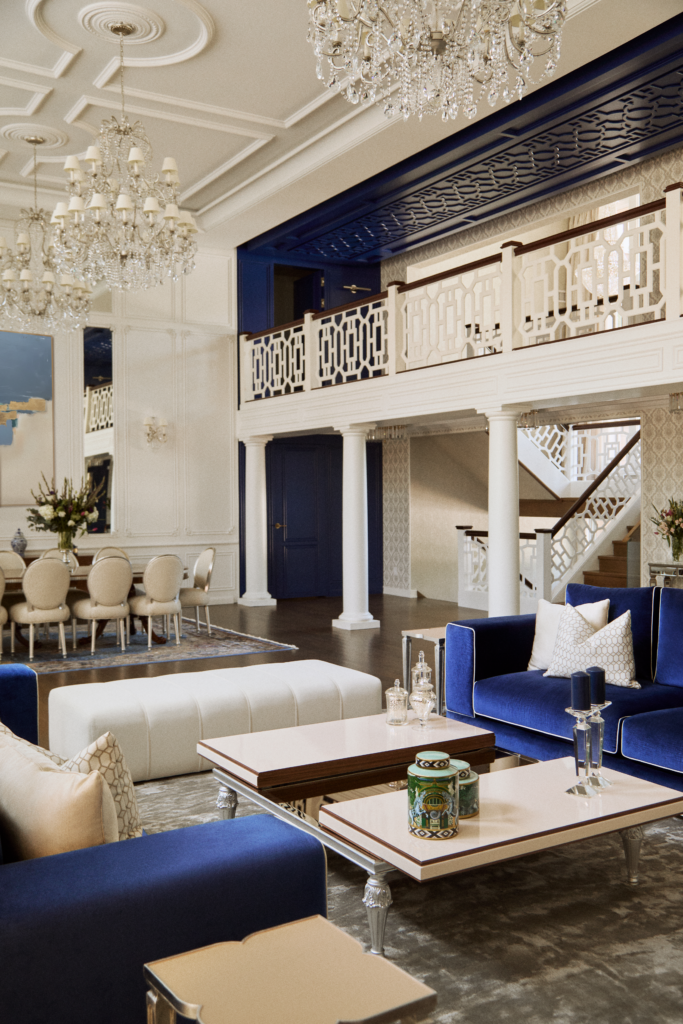
The global luxury interior design market was valued at $28.6 billion in 2025 and is projected to reach $54.8 billion by 2034 – a trajectory driven in large part by demand for the kind of design-led, craftsmanship-first interiors that French design has championed for centuries. As high-net-worth homeowners increasingly invest in transforming existing spaces rather than relocating, turnkey renovation and bespoke millwork have become the definitive benchmarks of the industry’s premium tier. The following report was compiled from data aggregated between 2022 and 2026, drawing on global market studies, renovation cost benchmarks, millwork pricing datasets, and interior design project timeline analyses. Its purpose is to provide a rigorous, data-anchored reference for the defining characteristics of French-inspired interior design and to contextualize those characteristics within the broader luxury renovation landscape. The first table below identifies the core elements that distinguish authentic French style — from structure to finishing detail.
Table of Contents
ToggleFrench Style Interior Design: Core Defining Characteristics
French style interior design is recognized globally for its design and historical depth, restrained material palette, and capacity to harmonize centuries of design heritage with contemporary living. The table below identifies the ten characteristics most consistently present in authentic French-inspired interiors, spanning structural features, surface treatments, and finishing details.
The Core Characteristics of French Style Interior Design — 2026
Design Element | Category | Description | Role in the Aesthetic |
Crown Molding & Boiserie | Architecture | Ornate plaster or carved wood wall and ceiling paneling | Establishes architectural grandeur; the structural signature of the style |
Herringbone Oak Parquet | Flooring | Angled interlocking hardwood planks in a broken zigzag pattern | Adds warmth, rhythm, and historical continuity underfoot |
Marble or Stone Fireplace | Focal Feature | Carved stone mantel as the primary room anchor | Commands the room; present in ~85% of Haussmann-era Parisian residences |
Tall Casement Windows | Natural Light | Floor-to-ceiling glazing, often with divided panes or Juliet balconies | Maximizes natural light; foundational to Haussmannian architecture (1853–1870) |
Neutral & Muted Color Palette | Color | Whites, creams, dusty grays, soft sage — applied in flat or limewash finishes | Provides an airy, restrained backdrop for layered furnishing and art |
Gilded Accents & Brass Hardware | Finishing Detail | 22–24k gold leaf on mirrors, cornices, and door hardware | Luxury punctuation rooted in Grand Siècle and Art Deco French tradition |
Antique & Curated Furnishings | Furniture | Louis XIV–XVI chairs, armoires, and settees blended with modern silhouettes | The deliberate mix of old and new is the philosophical core of the style |
Toile, Damask & Silk Textiles | Soft Furnishings | Narrative-patterned or woven fabrics in silk, linen, and velvet | Textile tradition originating in Jouy-en-Josas (est. 1760); layers pattern and tactility |
Crystal or Wrought Iron Chandeliers | Lighting | Multi-tiered pendant fixtures as primary ambient source | Introduces drama and luminosity; found in 70%+ of luxury French-inspired renovations |
Aubusson or Savonnerie Rugs | Floor Covering | Hand-woven flatweave or knotted pile rugs with floral or geometric motifs | Origin in French royal manufactories; premium markers of authenticity and provenance |
Space before decoration. French style design is defined by its structural bones, specifically molding, parquet, and carved stone, before any furnishing decision is made. This is what separates it from surface-level approximations and is precisely where design expertise becomes irreplaceable.
The palette is restrained, not minimal. Neutrals function as a calculated canvas. The visual tension between cream walls and black ironwork, gilded accents, or forest green velvet is where the style’s sophistication is expressed — not in any single element, but in the calibrated contrast between them.
The old-and-new principle requires trained expertise to execute. The coexistence of Louis XVI seating with a contemporary light fixture is one of the most recognizable hallmarks of the style — and one of the most technically demanding. Executing it credibly requires dual expertise in understanding the building’s characteristics and design: the kind of fluency that allows a practitioner to read period proportion, scale, and material weight simultaneously.
Luxury Renovation Cost Benchmarks by Tier
Realizing authentic French style interior design characteristics demands investment commensurate with the scope. The table below benchmarks renovation cost per square foot across five market tiers, from cosmetic refresh to ultra-luxury estate, providing a clear calibration of where bespoke, design-led projects are positioned within the broader renovation market.
Luxury Renovation Cost Per Square Foot by Tier — 2026
Renovation Tier | Cost Per Sq Ft | Typical Total Budget (2,000 sq ft) | Defining Scope |
Cosmetic / Surface-Level | $50–$100 | $20K–$80K | Paint, fixtures, and soft furnishings; no structural intervention |
Mid-Range Renovation | $100–$250 | $80K–$200K | Kitchen and bath updates, standard flooring, off-the-shelf millwork |
High-End Renovation | $300–$600 | $250K–$600K | Custom millwork, layout modifications, premium material specification |
Luxury Turnkey | $600–$1,200 | $500K–$1.5M | Full architectural scope, bespoke joinery, curated FF&E, design fees |
Ultra-Luxury / Estate | $1,200–$2,500+ | $2M–$10M+ | Complete gut, artisan craftspeople, period-accurate material sourcing |
Renovation and remodeling services accounted for 47.85% of the entire interior design services market in 2025, growing at an 11.78% CAGR through 2031, confirming that structured, professionally managed renovation is the industry’s primary growth engine at every price tier.
Premium and luxury-tier projects are growing at the fastest rate among all pricing segments, at a projected to grow 13.84% CAGR through 2031, reflecting the sustained expansion of the ultra-high-net-worth population and its increasing appetite for bespoke residential environments.
In major metropolitan markets, the construction phase of a luxury renovation regularly reaches $400–$600 per square foot before interior design fees, FF&E procurement, and bespoke millwork fabrication are added, underscoring the importance of a single, coordinated turnkey contract over piecemeal project management.
Bespoke Millwork vs. Stock Cabinetry: Cost, Quality & Value
Custom millwork is one of the highest-leverage decisions in any French-inspired renovation. As a signature offering of the most respected luxury design studios, bespoke joinery delivers measurable advantages in durability, design precision, and long-term value over standard alternatives. The table below compares stock, semi-custom, and fully bespoke millwork options across seven dimensions relevant to a luxury client’s investment decision.
Customization services, encompassing bespoke furniture, millwork, and joinery, were the largest service segment of the global luxury interior design market in 2025, representing 35.6% of revenues, or approximately $10.2 billion globally.
The longevity premium is bespoke millwork’s most underrated value driver. A custom joinery installation lasting 40 or more years delivers a materially lower total cost of ownership than two or three stock cabinet replacement cycles over the same period, particularly when accounting for demolition, disposal, and reinstallation labor at each interval.
Luxury design studios sourcing bespoke millwork from master craftspeople manage individual commission budgets ranging from $50,000 to $2 million per bespoke piece, with complex multi-room installations carrying fabrication periods of 6 to 18 months, which is a timeline that makes early-stage procurement coordination a critical project management competency.
Turnkey Luxury Renovation Timeline by Phase
One of the defining advantages of a turnkey renovation model is the seamless, end-to-end management of every project phase under a single design authority, from the first site assessment to the final placement of art and furnishing. The table below maps the typical phase structure and associated timelines for a full-scope, French-inspired luxury renovation.
Luxury Turnkey Renovation Timeline by Phase — 2026
Project Phase | Estimated Duration | Key Deliverables |
Initial Consultation & Discovery | 2–4 weeks | Site survey, client brief development, vision documentation |
Concept Design | 4–6 weeks | Mood boards, spatial layout proposals, preliminary material palette |
Design Development | 8–16 weeks | Technical drawings, bespoke specifications, contractor coordination |
Permitting & Pre-Construction | 4–12 weeks | Building permits, early material procurement, subcontractor scheduling |
Construction / Renovation | 12–24 weeks | Structural modifications, mechanical systems, surface finishes |
Custom Millwork Fabrication | 8–20 weeks (concurrent) | Atelier production of bespoke joinery and built-in cabinetry |
Styling & Final Installation | 2–6 weeks | FF&E placement, art, textiles, accessories, final punch list |
Total Turnkey Delivery | 9–18 months | End-to-end, fully realized interior |
High-end turnkey renovation projects consistently range from 9 to 18 months in total duration, with design development and active construction representing the two longest sequential phases. Projects involving structural reconfiguration or period-accurate restoration extend toward the upper end of this range.
The concurrent fabrication model, where bespoke millwork is produced in a craftspeople’s atelier simultaneously with the construction phase, is one of the clearest operational distinctions between a coordinated turnkey delivery and an unmanaged renovation. It reduces overall project duration without compromising joinery quality.
Full-service luxury interior design firms typically charge 12% to 25% of total project cost in design and management fees, which is a structure that reflects the comprehensive scope of services: procurement oversight, contractor coordination, on-site administration, and the creative and technical authorship of every design decision across the full project arc.
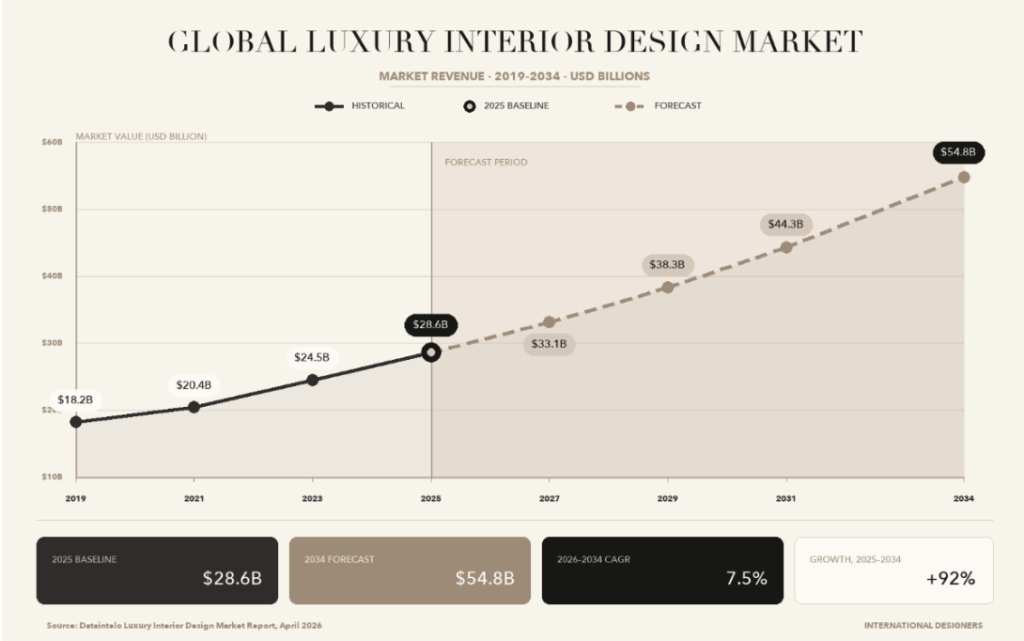
Global Luxury Interior Design Market Growth: 2019–2034
French-inspired interior design and luxury turnkey renovation sit at the intersection of two of the fastest-growing segments in the global interior design economy: the premium residential tier and the bespoke customization service category. The market data below establishes the sector’s historical trajectory and its projected scale through 2034.
The global luxury interior design market is on track to nearly double in value between 2025 and 2034, with residential design (38.4% market share) and bespoke customization services (35.6% of service revenues) leading the expansion across all regions.
The renovation services sub-segment is projected to grow at the fastest individual CAGR of 8.4% through 2034, a structural reflection of the “improve rather than relocate” preference now dominant among high-net-worth households in mature property markets globally.
The UHNW population, which is the primary client base for turnkey luxury renovation and French-inspired interior projects, surpassed 226,000 individuals globally in 2025, with each individual owning an average of 2.7 homes and controlling collective wealth in excess of $45 trillion, according to Knight Frank’s 2025 Wealth Report.
Bringing French Style Interior Design Characteristics to Life
French style interior design is not a trend to approximate. The characteristics that define it, from hand-carved boiserie and herringbone parquet to gilded accents and bespoke millwork, are not decorative gestures. They are structural commitments that require a practitioner trained to understand how a room is built before deciding how it is furnished. In a luxury renovation market valued at $28.6 billion and growing at 7.5% annually, the clients investing at this level are entrusting an interior designer with the transformation of their most significant spaces, and they expect the full scope of that responsibility to be held by a single, expert hand.
Rita Chraibi leads the conceptual interior design and creative direction of commissions undertaken through International Designers, creating highly individualized interiors shaped by proportion, materiality, craftsmanship, furniture, art, and bespoke design.
Schedule a Private Consultation
Sources
- Dataintelo. Luxury Interior Design Market Research Report 2025–2034. April 2026. https://dataintelo.com/report/luxury-interior-design-market
- Mordor Intelligence. Interior Design Services Market Size & Share Analysis – Growth Trends and Forecast 2026–2031. 2026. https://www.mordorintelligence.com/industry-reports/interior-design-services-market
- Grand View Research. Interior Design Market Size, Share & Growth Report, 2033. 2026.