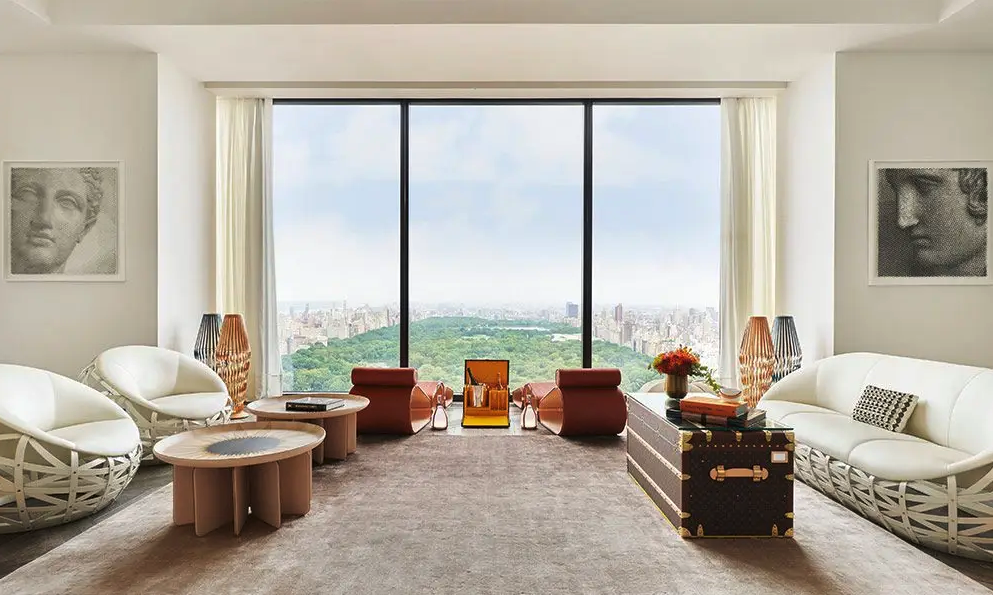
In New York, a truly bespoke interior is defined by far more than ornament, furnishings, or expense. It begins with precision: proportion, light, spatial relationships, materiality, craftsmanship, and the way every element contributes to the experience of a home.
For French interior designer and Creative Director Rita Chraibi, these elements are considered as part of one complete interior composition. A library, a ceiling detail, the transition between rooms, a custom piece of furniture, or the relationship between stone and wood is never conceived in isolation. Each belongs to a larger design language created specifically for the residence.
That distinction is particularly relevant in New York, where luxury residential interiors may exist within pre-war buildings, landmark properties, contemporary towers, newly built residences, or exceptional private homes.
Creating an interior at this level requires more than aesthetic refinement. It requires a disciplined understanding of proportion and space, exceptional materials and craftsmanship, close project coordination, and a design process capable of preserving a clear creative vision from the earliest concept through final installation.
Through International Designers and Maison Royale, her private atelier in France, Rita Chraibi brings a distinctly French approach to residences in New York and internationally.
Her work encompasses conceptual interior design, creative direction, material development, furniture, art, bespoke elements, procurement, installation coordination, and final styling.
The objective is never simply to create a luxurious interior. It is to create a residence with an identity entirely its own.
For clients considering a luxury interior designer in New York City, the following six firms represent distinctive approaches to high-end residential design in 2026.
How the Firms Were Selected
Between May and July 2026, firms serving the New York luxury residential market were reviewed with particular attention to practices working on highly individualized private residences and substantial interior projects.
The editorial assessment considered five principal criteria:
Conceptual Interior Design & Spatial Approach — 25%
The sophistication with which each practice approaches proportion, circulation, spatial relationships, materiality, and the overall identity of a residence.
Project Continuity & Coordination — 20%
The ability to maintain a coherent creative vision from conceptual development through sourcing, fabrication, procurement, installation, and completion.
Bespoke Design & Custom Fabrication — 20%
The extent to which custom furniture, cabinetry, millwork, joinery, and decorative elements can be developed specifically for an individual project.
Experience with Major Residential Projects — 20%
Demonstrated experience with substantial private residences, luxury penthouses, major interior transformations, and other complex residential environments.
Client Experience & Principal Involvement — 15%
The degree of senior creative involvement, communication, continuity, discretion, and individualized attention available throughout the project.
Editorial Note
This guide is published by International Designers, which is included in the comparison.
The firms were assessed according to the criteria above using publicly available information reviewed in 2026. The objective is not to suggest that one design philosophy is universally preferable to another, but to help clients understand the different strengths, structures, and creative approaches available within the New York luxury residential market.
The Top Luxury Interior Design Firms in New York City in 2026
| # | Firm | Conceptual Approach | Project Continuity | Bespoke Design | Residential Experience | Best Suited For |
|---|---|---|---|---|---|---|
| 1 | International Designers | École Camondo–trained, concept-led French approach to proportion, light, materiality, and spatial relationships | Principal-led creative direction through bespoke development, procurement, installation coordination, and styling | Maison Royale private atelier in France | Luxury penthouses, exceptional private residences, estates, waterfront homes, and significant interior transformations | Highly individualized, atelier-crafted interiors conceived specifically for the residence |
| 2 | Cullman & Kravis | Sophisticated modern-traditional decorative approach | Established full-service residential design structure | Custom furniture and specialist trade resources | Extensive high-end residential portfolio | Art, antiques, layered decoration, and modern American traditionalism |
| 3 | Pembrooke & Ives | Strong interior architecture and spatial planning capabilities | Large multidisciplinary studio structure | Custom finishes and specialist fabrication resources | Private residences and substantial development-scale projects | Large residences, interior architecture, and residential developments |
| 4 | Ovadia Design Group | Architecture and interior design within one multidisciplinary practice | Integrated organizational structure | Custom interior specification | Residential and commercial projects | Clients seeking architecture and interiors within one firm |
| 5 | Neal Beckstedt Studio | Architecture-informed contemporary design with strong material emphasis | Boutique full-service studio | Custom and trade-sourced furnishings and materials | High-end residences in New York, the Hamptons, and Miami | Refined contemporary interiors and sophisticated materiality |
| 6 | Kati Curtis Design | Sustainability- and wellness-informed interior design | Principal-led full-service structure | Custom specification with sustainable material emphasis | Boutique luxury residential projects | Sustainable luxury, art, and wellness-conscious interiors |
— Scroll to explore —
- International Designers
For Bespoke Interiors Conceived as a Complete Interior World
French interior designer and Creative Director Rita Chraibi founded International Designers in 2013 after studying at École Camondo in Paris.
Her work begins not with individual objects or decorative gestures, but with the identity of the residence itself.
Proportion, circulation, natural light, materials, furniture, art, textiles, lighting, and bespoke elements are considered together from the beginning so that the finished interior reads as one coherent composition.
This French design culture has shaped projects in New York, Greenwich, Miami, Palm Beach, Paris, and selected international destinations.
Rather than applying a recognizable house style from one residence to another, Rita develops an individual creative language for each project.
The architecture of the interior, the material palette, the furniture, the art, and the custom elements are conceived in relation to one another.
The result may be restrained in one residence and expressive in another, contemporary in one room and informed by French decorative tradition in the next. What remains constant is the rigor of the composition.
Louis Vuitton Private Residence at Steinway Tower
In 2022, Louis Vuitton selected Rita Chraibi to conceive the interiors of the world’s first Louis Vuitton Private Residence at Steinway Tower in New York.
Created as an exceptional residential setting for the Maison’s Objets Nomades collection, the project brought together collectible design, contemporary art, exceptional materials, lighting, and bespoke furnishings within the intimacy of a private residence.
Rather than presenting the collection as a sequence of individual design objects, Rita conceived an interior environment in which the pieces could exist naturally as part of a home.
For the bedrooms and other selected spaces, she designed custom beds and furnishings specifically for the project, created through Maison Royale, her private atelier in France.
The residence illustrates one of the central principles of her work: collectible objects and bespoke elements should belong to one coherent interior narrative rather than exist as separate decorative statements.
Maison Royale
Maison Royale extends this philosophy into bespoke creation.
The atelier is not approached simply as a fabrication resource added at the end of the design process.
Selected furniture, cabinetry, millwork, wall treatments, beds, tables, decorative pieces, and other custom elements may be conceived as part of the interior itself and developed specifically for the residence.
This allows the relationship between the interior and the objects within it to remain unusually precise.
A piece is not selected merely because it fits the room. It can be created because the room requires it.
For selected residences, this philosophy reaches its most exclusive expression through Only Once.
The principle is simple: an interior or piece is conceived for one residence, created once, and never repeated.
Conceived once. Created once. Never repeated.
A Principal-Led Creative Process
International Designers remains intentionally selective.
Rita Chraibi maintains direct creative oversight of the projects she leads, allowing the original conceptual vision to remain consistent through material development, bespoke design, furniture selection, procurement, installation coordination, and final styling.
This principal-led structure is particularly relevant to clients seeking a highly individualized residence rather than the application of a predetermined studio aesthetic.
The objective is not simply consistency of style. It is consistency of thought.
Each decision belongs to the identity established for the residence from the beginning.
International Recognition
Rita Chraibi’s work has received international recognition across residential and interior design.
Her distinctions include Best Luxury Residence in the World, Best Interior Designer of the Year in the United Kingdom, recognition from the SBID International Design Awards, The International Design & Architecture Awards by design et al, Luxe RED Awards, the A’ Design Award & Competition, and Platinum and Gold distinctions from the MUSE Design Awards.
Her work has also been featured by international design, fashion, luxury, and business publications including AD PRO, Forbes, ELLE Decor, Harper’s Bazaar, Robb Report, and WWD.
Location: New York, with studios in Greenwich, Miami, and Paris; projects internationally
Best For: Luxury penthouses, exceptional private residences, landmark estates, waterfront homes, significant interior transformations, and highly individualized bespoke interiors
Services: Conceptual interior design, creative direction, material and finish development, furniture selection, bespoke furniture and decorative elements, Maison Royale atelier production, procurement, installation coordination, and final styling
- Cullman & Kravis
For Layered American Traditionalism
Cullman & Kravis is one of New York’s established luxury residential interior design practices.
The firm is particularly associated with a sophisticated modern-traditional approach in which antiques, custom furniture, art, textiles, pattern, and contemporary pieces are layered to create interiors with depth and personality.
Its long residential history makes the practice particularly relevant for clients drawn to highly considered decorative interiors in which furniture, collections, and art play a central role.
Rather than relying on a single historic vocabulary, Cullman & Kravis is known for bringing pieces from different periods and origins together through a contemporary eye.
For clients seeking richly layered New York interiors informed by American decorative tradition, the practice remains one of the city’s recognized names.
Location: New York, NY
Best For: Layered private residences, art collections, antiques, and modern-traditional interiors
Services: Interior design, decoration, furniture selection and specification, custom furniture, and residential project coordination
- Pembrooke & Ives
For Interior Architecture and Large-Scale Residential Design
Founded by Andrew Sheinman in 1987, Pembrooke & Ives has developed into one of New York’s substantial multidisciplinary interior design practices.
Its portfolio ranges from private residences and Manhattan apartments to residential developments and international projects.
The studio’s scale allows it to bring extensive resources to complex projects, with capabilities spanning conceptual development, spatial planning, interiors, detailing, furnishings, and installation.
Its body of work makes the firm particularly relevant for substantial residences and development-scale projects requiring a broad multidisciplinary design structure.
Its aesthetic varies according to context, allowing the practice to work across different architectural environments and residential typologies.
Location: New York, NY
Best For: Large residences, interior architecture, and development-scale residential design
Services: Concept development, interior architecture, interior design, design development, furnishing, installation, and residential development design
- Ovadia Design Group
For Architecture-Integrated Residential and Commercial Design
Ovadia Design Group is a New York–based multidisciplinary practice led by Jack Ovadia.
The firm combines architecture and interior design within one organization, distinguishing it for clients seeking those disciplines within an integrated practice.
Its work spans high-end residential projects, commercial interiors, and mixed-use environments throughout the New York metropolitan area and beyond.
Spatial planning and lifestyle considerations play an important role in the studio’s approach, particularly on projects involving substantial reconfiguration.
The firm may therefore appeal particularly to clients seeking a multidisciplinary organization addressing architecture and interiors within the same practice.
Location: New York, NY
Best For: Architecture-integrated residential and commercial projects
Services: Architecture, interior design, space planning, residential design, and commercial design
- Neal Beckstedt Studio
For Layered Materials and Contemporary Residential Refinement
Neal Beckstedt Studio is a New York–based design practice known for sophisticated contemporary interiors combining architectural clarity with warmth and material richness.
Before establishing his studio, Neal Beckstedt studied architecture and spent nearly a decade working with S. Russell Groves.
That background is reflected in the practice’s attention to proportion, volume, material transitions, and spatial composition.
Its interiors frequently bring together clean architectural lines, vintage furniture, tactile textiles, contemporary pieces, art, and carefully controlled palettes.
The result is residential design that feels polished without becoming overly formal.
The studio is particularly relevant for clients seeking contemporary New York interiors with strong material depth and understated refinement.
Location: New York, NY
Best For: Contemporary residences, sophisticated material palettes, and layered modern interiors
Services: Interior design, residential design, space planning, furnishing, and renovation coordination
- Kati Curtis Design
For Sustainable and Art-Led Luxury Interiors
Founded in 2005, Kati Curtis Design brings sustainability, art, and material responsibility into luxury residential interiors.
Kati Curtis is a LEED Accredited Professional and Certified Interior Designer, and her work reflects a longstanding interest in environmental performance, responsible sourcing, wellness, and material health.
These principles are incorporated alongside the expressive qualities of high-end residential design.
Art, pattern, color, custom elements, and globally influenced references frequently contribute to the finished interiors.
For clients who want sustainability and material responsibility to form a meaningful part of their design brief, Kati Curtis Design offers one of the more clearly defined approaches within the New York luxury residential market.
Location: New York, NY
Best For: Sustainable luxury interiors, wellness-conscious residences, and art-led design
Services: Full-service interior design, sustainable design, furnishing, art curation, and project coordination
How to Choose a Luxury Interior Designer in New York City
Selecting a luxury interior designer in New York should begin with the nature of the residence and the ambition of the project.
A Manhattan penthouse requiring an entirely new interior identity presents a different design challenge from a pre-war apartment, an art-filled residence, a newly built home, or an estate undergoing a major interior transformation.
A portfolio is therefore only the beginning.
Clients should also consider who establishes the creative vision, how directly that person remains involved, whether bespoke elements can be developed specifically for the residence, how procurement and installation are coordinated, and how the interior design team works alongside the other professionals required by the project.
For highly individualized residences, continuity is particularly important.
The strongest interiors often emerge when proportion, materials, furniture, lighting, art, craftsmanship, and final installation are treated as parts of one creative language rather than separate decisions made at different stages.
Frequently Asked Questions
What should I look for when selecting a luxury interior design firm in New York City?
Begin with the scope and ambition of the residence.
Look beyond individual photographs and consider whether the firm has experience with projects of comparable scale, quality, and complexity.
For a highly bespoke residence, examine the studio’s conceptual approach, the degree of principal involvement, its ability to create custom elements, its procurement and installation process, and the way it collaborates with the other professionals involved in the project.
One of the most revealing questions is whether completed residences feel individually conceived or whether the same aesthetic language appears repeatedly from one project to another.
What makes bespoke interior design different from luxury decorating?
Luxury and bespoke are not interchangeable.
A luxury interior may incorporate exceptional furniture, materials, fabrics, and art while still relying largely on existing products.
A truly bespoke interior begins with the residence itself.
Proportion, spatial relationships, materials, furniture, lighting, art, and custom elements are developed around the identity of that particular home.
Furniture and decorative elements may be conceived expressly for the project rather than selected from an existing collection.
The objective is therefore not simply to create an expensive or highly finished interior, but one that could not be reproduced in another residence without losing its meaning.
Why can major residential transformations in New York take longer to begin than expected?
New York residential projects can involve multiple layers of review depending on the building, location, and nature of the work.
Building management requirements, co-operative or condominium review procedures, construction rules, permits, and the involvement of architects, engineers, General Contractors, and specialist professionals may all affect the pre-construction period.
Projects involving regulated architectural, structural, engineering, or permitting work require the appropriate licensed professionals.
Early coordination between the interior design team and these professionals can help establish responsibilities, identify technical constraints, and reduce avoidable changes later in the process.
What does turnkey interior design mean?
The term turnkey can mean different things from one firm to another, so clients should ask exactly what is included.
Within high-end residential interior design, it often describes a comprehensive service extending beyond the creation of the design itself to areas such as sourcing, procurement, bespoke production, logistics, delivery coordination, installation, and final styling.
It does not necessarily mean that every professional service is performed by the interior design studio itself.
Architectural, engineering, construction, permitting, and other regulated services may be provided separately by appropriately licensed or qualified professionals.
The advantage of a comprehensive interior design process is continuity: the original creative concept remains visible through the final installation rather than ending at the design presentation.
Does a New York interior designer need to work with an architect?
It depends on the project.
Many interior design projects can be developed without architectural work. However, projects involving services that fall within regulated architectural or engineering practice, permitting requirements, structural changes, building systems, or other regulated scopes may require appropriately licensed architects, engineers, or other professionals.
On complex residential projects, the interior designer, licensed professionals, General Contractor, fabricators, and specialist consultants may therefore work alongside one another, each within their respective professional role.
Contact International Designers
International Designers works with private clients on exceptional residences in New York and selected international destinations.
Rita Chraibi leads the conceptual interior design and creative direction of her projects, creating highly individualized interiors shaped by proportion, materiality, craftsmanship, furniture, art, and bespoke design.
Private consultations may be requested through the studios in New York, Greenwich, Miami, and Paris.
New York: +1 (646) 793 9492
Greenwich: +1 (475) 500 2530
Miami: +1 (786) 763 0100
Paris: +33 1 40 07 80 30
Professional Services Notice
International Designers provides interior design, conceptual interior design, and creative direction services.
Architectural, engineering, permitting, construction documentation, code compliance, and other regulated professional services, where required, are provided by appropriately licensed local professionals within their respective professional scopes.